Artificial Intelligence is evolving at lightning speed, but some of the most exciting innovations aren’t happening behind closed doors—they are happening out in the open.
On October 28th, 2025, Howest hosted another fantastic Tech & Meet session that delved straight into the heart of this movement: “The Power of Open-Source AI.” The guest speaker for the evening was Niels Rogge, a Senior Machine Learning Engineer at ML6 (a premier Belgian AI consulting firm) who also works part-time on the open-source team at Hugging Face. Having someone who splits his time between cutting-edge enterprise AI consulting and the world’s largest open-source AI ecosystem made for an incredibly insightful session.
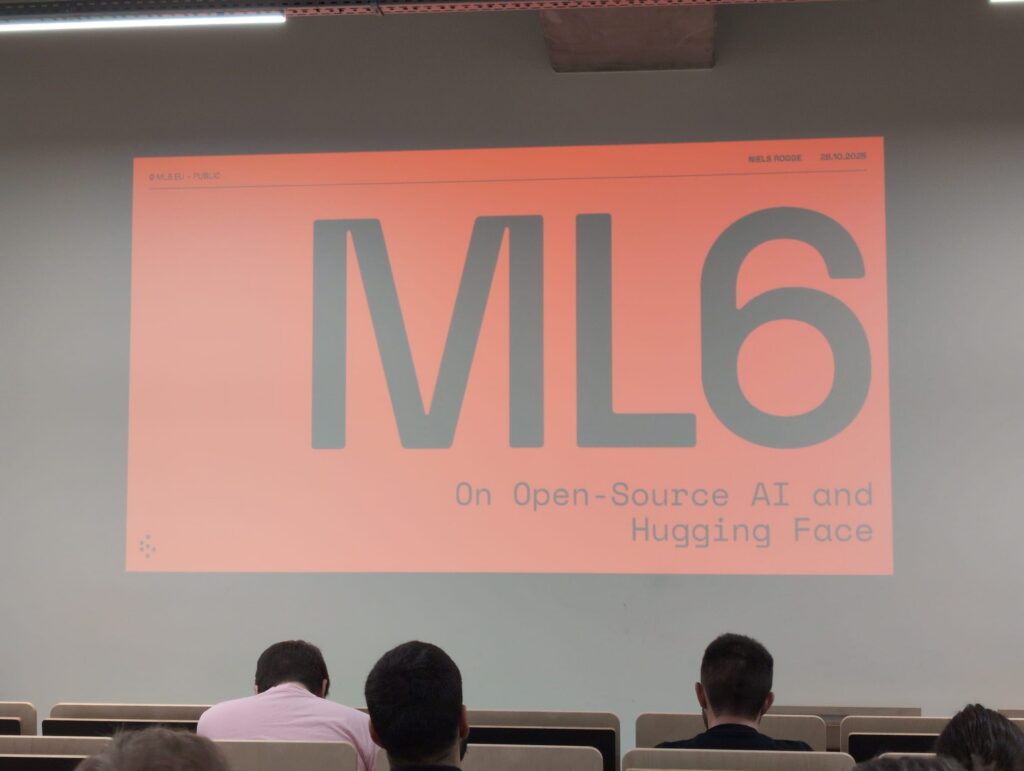
Open-Source vs. Closed-Source AI: The Big Debate
Niels kicked off the evening by breaking down the fundamental architectural and strategic differences between open-source and closed-source AI models.
While closed-source giants offer powerful out-of-the-box performance, open-source AI is rapidly closing the gap while offering distinct advantages that are crucial for modern organizations:
- Transparency & Security: With open source, you can inspect the code, architecture, and often the datasets. From a GRC perspective, this level of transparency is vital for auditing, bias detection, and ensuring data privacy.
- Control & Data Sovereignty: Organizations can host open-source models completely on their own infrastructure, ensuring that sensitive data never leaves their secure environment.
- Customization: Instead of relying on generic APIs, developers can fine-tune open-source models on domain-specific data to solve niche, highly specialized problems.
Diving into the Hugging Face Ecosystem
The highlight of the night was getting a guided tour of Hugging Face, which has truly become the ultimate hub for open-source AI. Niels shared how the platform makes AI accessible to developers and researchers worldwide by providing a massive repository of pre-trained models, datasets, and web apps (Spaces).
He showed us practical ways to get hands-on with these tools, demonstrating how easily someone can pull a state-of-the-art model and start experimenting locally. Seeing how streamlined the workflows have become was incredibly inspiring and proved that you don’t need a massive big-tech budget to start innovating with Generative AI.
Looking Ahead
Events like this highlight exactly why the Howest tech community is so unique. It connects us directly with industry leaders like ML6 and global platforms like Hugging Face, bridging the gap between theoretical computer science and real-world implementation.
Whether you’re looking to build an AI agent to optimize business compliance or just want to experiment with a local LLM on your laptop, the open-source community has given us the tools to do it. The future of AI is open, collaborative, and highly accessible!
Huge thanks to Niels Rogge for stopping by Campus Brugge and inspiring the next generation of builders. Did you attend the session? Let me know your favorite open-source model to work with in the comments!